


Milan Design Week returns every April, transforming the city into a sensory carnival where technology, craft and sustainability collide in bold, immersive installations.
At the 2026 Milan Design Week, designers and global brands turned public squares, historic palaces and neighborhood galleries into interactive stages, inviting visitors to touch, sit and walk through works that rethink material, memory and motion.
Below, ZTYLEZ guides you through 10 of the most talked about installations, from a giant inflatable octopus to a recycled bamboo chess table, each showing how design can reshape our sensory world.
Milan Design Week Spotlight: Moncler’s Ocean Embrace
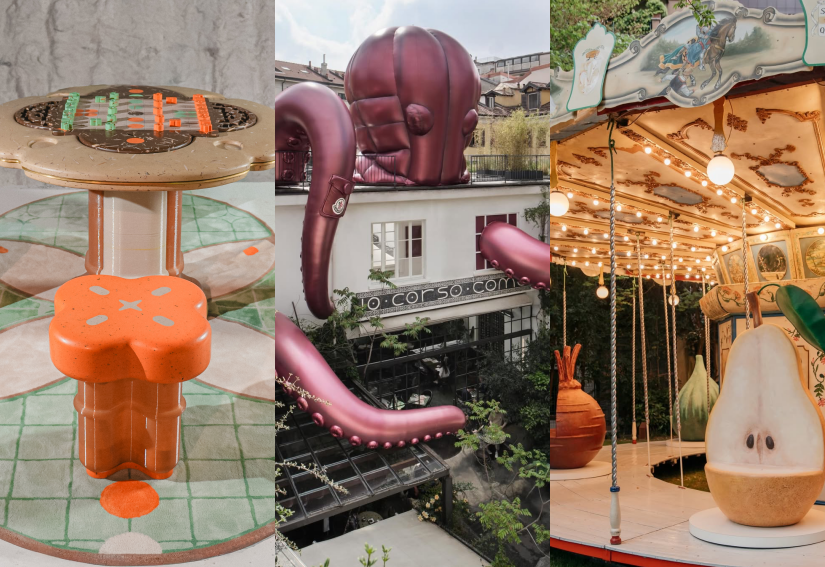
Outside the 10 Corso Como building in central Milan a giant inflatable octopus wrapped around the facade, its tentacles spilling over windows and balconies as if rising from the deep sea to embrace the structure.
The work was presented by Moncler, which said it translated the brand’s signature down filling into a pearlescent, air filled sculpture that extends into the building, turning galleries into caverns of soft form and light.
Moncler also staged parallel versions of the octopus in Seoul, Hong Kong, Tokyo and Paris, the brand said, using the installation to introduce its new lightweight summer collection.
reEDIT’s Recycled Chess Table, an East West Dialogue
In Isola, a design neighborhood in Milan, the No Space for Waste exhibition featured Hong Kong upcycling studio reEDIT with a project called Bamboo Chess Tea Table, an upgraded reclaimed chess table and chair set that blends function with cultural storytelling.
The piece combines discarded bamboo and rPETG recycled plastic with leftover tea leaves from Hong Kong style milk tea to create a tabletop whose graduated tones resemble a tea lake, the studio said, while 3D printed pieces merge elements of Chinese xiangqi and Western chess to symbolize cultural exchange.
reEDIT founder Jacqueline Chak said the work is not just a table, but a cultural vessel that uses waste to tell Hong Kong’s story and to remind visitors of the value of face to face conversation in a digital age.
Škoda’s Colorful Inflatable Sculptures Bring Play to a Palace
Automaker Škoda occupied the courtyard of a 17th century Milanese palazzo with Ooooh, that is EpiQ, a field of large, inflatable fluorescent forms that look like alien organisms frozen mid drift.
The carmaker and Spanish architect digital artist Ricardo Orts said they used biodegradable materials to create a range of round and irregular shapes that sway in the breeze and stage a color and sound show at night, echoing Škoda’s new electric vehicle designs in an abstract, poetic way.
Škoda framed the installation as a playful invitation to imagine future mobility from a sensory angle rather than a technical one.
ARKET’s Fruit Carousel, a Toy for Adults
Nordic lifestyle brand ARKET teamed with artist Laila Gohar to install a concept carousel at Giardino delle Arti, swapping horses for 1 to 5 scale, oversized fruits and vegetables that visitors can actually sit on as they rotate.
The work references an antique late 18th century carousel form while replacing figurative mounts with giant pears, eggplants and onions that turn slowly to a gentle soundtrack, the brand said, turning everyday food into a moment of wonder.
Veuve Clicquot’s Chasing the Sun Garden in Yellow
Champagne house Veuve Clicquot installed Chasing the Sun, an immersive garden made up of sunflowers, calendula and yellow tulips rendered in the brand’s Clicquot Yellow, accompanied by a pop up Clicquot Café.
Designer Yinka Ilori and chef Andrea Mattasoglio collaborated on the floral maze and a limited menu that links Ilori’s visual motifs to seasonal dishes, Veuve Clicquot said, creating a multisensory path of color, scent and taste.
Buccellati’s Aquae Mirabiles, Jewelry Meets Water
Italian jeweler Buccellati staged Aquae Mirabiles on Via Montenapoleone, an immersive show curated by Federica Sala with Balich Wonder Studio and artist Luke Edward Hall that opened around the brand’s new Caviar silverware collection.
The exhibition uses blue green tones and mirrored surfaces to create a watery visual maze where carved metalwork meets fluid light, Buccellati said, positioning handcrafted technique as a counterpart to nature’s movement.
Gucci Memoria: Time and Brand Memory
At Chiostri di San Simpliciano, Gucci presented Gucci Memoria, an exhibition curated by creative director Demna that blends the monastery’s quiet cloisters with forward leaning installations tracing the label’s archive.
The centerpiece is a chronological tapestry made of 12 woven panels that compress the brand’s century of moments into cinematic scenes, Gucci said, inviting viewers to walk through memory, time and pattern.
Aesop’s Lab of Light and Craft
Australian skincare brand Aesop installed The Factory of Light, designed by architect Rodney Eggleston, an experience that connects hand craft, restoration and the perception of time.
Aesop said the path begins with a restorative hand treatment, moves through an optical illusion corridor fashioned from reclaimed facades and ends inside a rolling wave made from 10,826 amber glass bottles, a meditation on human touch and material life cycles.
Louis Vuitton’s Travel Worlds Inside a Trunk
At Palazzo Serbelloni Louis Vuitton turned the palace into a surreal time capsule, using the brand’s trunks as portals to micro universes that pay homage to Art Deco pioneers such as Pierre Legrain.
The presentation included vintage trunks and contemporary pieces from the Objets Nomades program, along with a lacquered Celeste dressing table remade in luxurious wood and leather, the house said, balancing nostalgia and experimental forms.
Lina Ghotmeh’s Metamorphosis in Motion
Lebanese born architect Lina Ghotmeh, based in Paris, presented Metamorphosis in Motion at Palazzo Litta, an installation that blurs the boundary between architecture and biology with an ever shifting labyrinth of structure, light and material.
Ghotmeh said the work invites a state of slow time, prompting visitors to consider how built environments might adapt to natural rhythms.
Milan Design Week remains compelling because it does more than display aesthetics and innovation, it stages collective experiments in possibility: each installation reframes how we relate to space, objects and one another, and every corner of the city can still yield an unexpected surprise.