



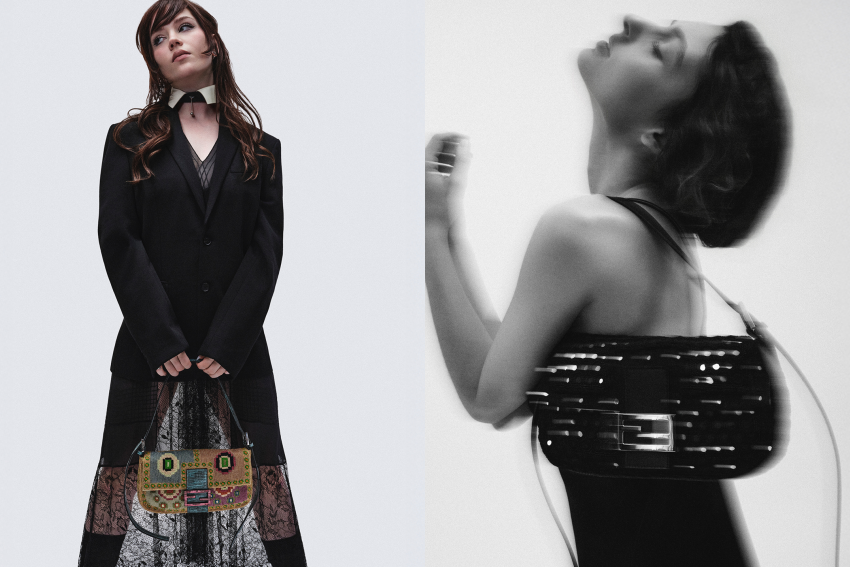
Fendi Baguette campaign returns the house classic for a new season, and the first advertising images under the creative direction of Maria Grazia Chiuri cast a global roster of stars to tell the bag’s story.
Launched in 1997, the Baguette took its name from the French long loaf and quickly became a signature of the late 1990s, Fendi said in a press release.
At a moment when 1990s minimalism favored understatement and function, the Baguette pushed back with bold colors, mixed materials and experimental craftsmanship, shifting a handbag from accessory to a portable expression of identity.
Fendi Baguette campaign: the cast and creative team
The Fendi Baguette campaign brings together actors, musicians, and the house’s ambassadors, including Sarah Jessica Parker, Fong Caan (方燦), Song Yuqi, Ren Meguro, Mina, Jessica Alba, Emma D’Arcy, Sophie Thatcher, Iris Law and Tecla Insolia, Fendi said.
Photographer Bibi Borthwick staged the images with an intimate approach, framing the bag as something worn and lived with rather than only displayed.

The campaign repeats declarative phrases such as “it’s mine,” “it’s my attitude,” “it’s controlled chaos,” “it’s family,” and “it’s history,” and closes with the line “it’s not a bag, it’s a Baguette®.”
Those taglines deliberately link the Baguette to personal memory and identity, and the copy nods to Carrie Bradshaw’s line in Sex and the City by treating the bag as a cultural shorthand for self expression.
With Maria Grazia Chiuri at Fendi for her first season, the house has restored the Baguette to its original design language and reinstated its original code, 26424, the company said, framing the move as both a revival and a redefinition for now.

Borthwick’s frames prioritize movement and ownership; the Baguette appears in mid gesture, draped over an arm, or tucked under one shoulder, suggesting how the bag functions in real life rather than as a static object.
Fendi described the campaign as an effort to reconnect the object to collective memory and contemporary style, positioning the Baguette as both a historical reference and a continuing mode of personal expression.