


Side Core art in Hong Kong
Z: How will the works you show at Art Central 2026 engage with Hong Kong’s urban context? What street-culture elements or spatial qualities in Hong Kong caught your attention during your research?
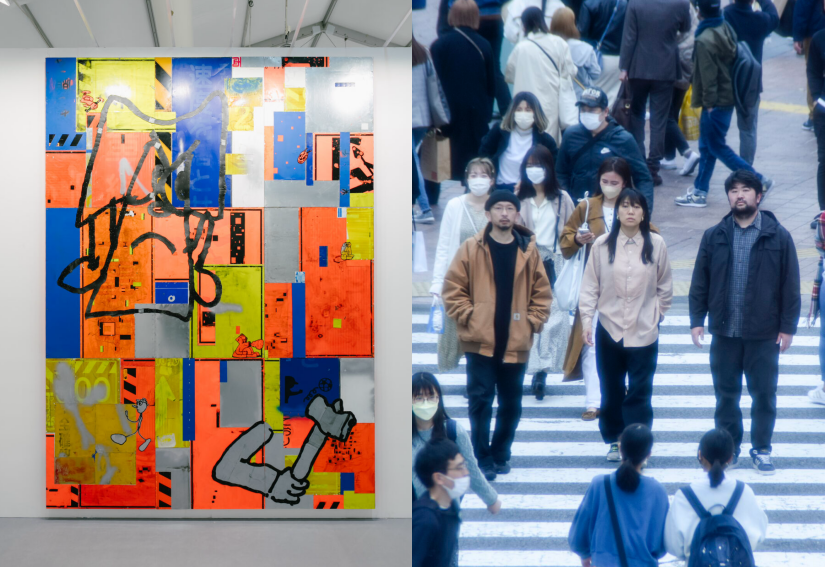
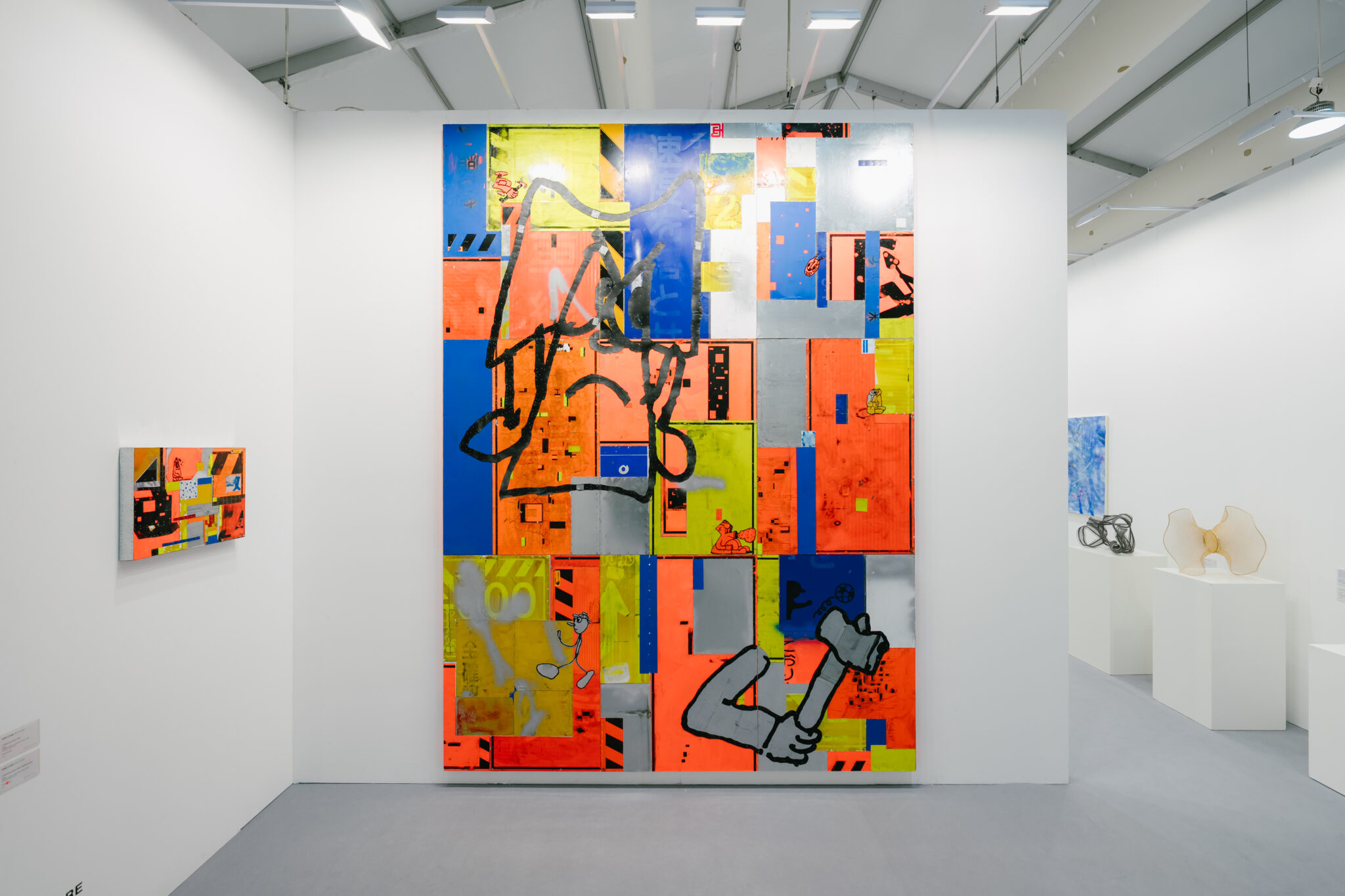
SC: The works we showed at Art Central 2026 were collages of Japanese construction and street signs originally used in public space, which we see as symbols of a city in flux. In a sense they connect street context and the art-fair context. While walking in Hong Kong we noticed the entire city is constantly under development, and similar signs appear everywhere, much as in Japan. Going forward, we want to produce a collage that blends Hong Kong and Japanese architectural signage.
Globalization and the street
Z: With globalization and digitization, how do you see the concept of “the street” evolving, and what role will artists play?
SC: Regarding street culture, we have heard that graffiti blossomed globally after the COVID-19 pandemic. In Tokyo, urban redevelopment has reduced the number of graffiti sites, while in Osaka graffiti seems to be increasing. We believe street expressions will continue to expand over the next decade, and that growth often correlates with broader social instability. It is important to keep generating ideas and taking action even in difficult times, and we must listen to and trust the potential of younger generations, regardless of age.
SIDE CORE solo exhibition “under city”
Dates: March 21 to May 16, 2026
Hours: Saturday, 12 p.m. to 6 p.m.; Monday through Friday by appointment only; closed Sundays and public holidays
Location: wamono art, 10/F, Block A, Tel: 49 Tak Lee Industrial Building, Wong Chuk Hang Road, Wong Chuk Hang (a neighborhood on Hong Kong Island’s south side)
*To book, WhatsApp +852 6822 2962
Institutions as public space
Z: Your project sites range from skate parks to museums to disaster-affected terrain. How do these different spaces reconnect and register in your practice? When “publicness” meets institutional art space, what tensions and possibilities arise, and how does that strategy challenge museum function and audience experience?
SC: Historically, museums have validated certain authorities as “art” and excluded others. We were encouraged when a young curator who had been thinking about transforming museums contacted us after the Noto Peninsula earthquake, and used the moment to put those ideas into practice.
In Kanazawa’s 21st Century Museum of Contemporary Art, the creation of a skate park aimed to open the museum to a broader public. The city has many skateboarders and many families who visit museums. During the exhibition, local skateboarders came almost every day, and for many children the skate park functioned like a public playground. The graffiti on the walls evolved over time. We think this kind of practice is still rare in Japanese museums.
We also think that framing street and museum as a strict binary is an outdated postmodern view. Many museums in Japan are publicly funded and can function like a public square; as parts of the city they should be open to people. The idea of the white cube as a neutral, sterile environment is also outdated; every museum has local character and a specific political environment. Whether in the street or in a museum, each space has its personality, and the important task is finding the most suitable form of expression for a given place and moment.
Side Core art in Hong Kong
Z: How will the works you show at Art Central 2026 engage with Hong Kong’s urban context? What street-culture elements or spatial qualities in Hong Kong caught your attention during your research?
SC: The works we showed at Art Central 2026 were collages of Japanese construction and street signs originally used in public space, which we see as symbols of a city in flux. In a sense they connect street context and the art-fair context. While walking in Hong Kong we noticed the entire city is constantly under development, and similar signs appear everywhere, much as in Japan. Going forward, we want to produce a collage that blends Hong Kong and Japanese architectural signage.
Globalization and the street
Z: With globalization and digitization, how do you see the concept of “the street” evolving, and what role will artists play?
SC: Regarding street culture, we have heard that graffiti blossomed globally after the COVID-19 pandemic. In Tokyo, urban redevelopment has reduced the number of graffiti sites, while in Osaka graffiti seems to be increasing. We believe street expressions will continue to expand over the next decade, and that growth often correlates with broader social instability. It is important to keep generating ideas and taking action even in difficult times, and we must listen to and trust the potential of younger generations, regardless of age.
SIDE CORE solo exhibition “under city”
Dates: March 21 to May 16, 2026
Hours: Saturday, 12 p.m. to 6 p.m.; Monday through Friday by appointment only; closed Sundays and public holidays
Location: wamono art, 10/F, Block A, Tel: 49 Tak Lee Industrial Building, Wong Chuk Hang Road, Wong Chuk Hang (a neighborhood on Hong Kong Island’s south side)
*To book, WhatsApp +852 6822 2962
From guerrilla to long-term research
Z: You were known for guerrilla interventions early on, and later shifted to long-term local research. Does that shift from “guerrilla” tactics to long-term work reflect a deeper thinking about cities and institutions?
SC: Many of our projects critique the centralized systems of the city and involve forms of action. When we work outside urban centers, we must research the historical relationship between the city and the area before starting. In other words, art practice outside the city requires a long-term approach; working inside the city and maintaining a critical view of it is relatively easier.
For example, in our recent solo show at wamono art we produced a new Hong Kong–themed work in a relatively short time. Some projects take years, others come together faster.
Institutions as public space
Z: Your project sites range from skate parks to museums to disaster-affected terrain. How do these different spaces reconnect and register in your practice? When “publicness” meets institutional art space, what tensions and possibilities arise, and how does that strategy challenge museum function and audience experience?
SC: Historically, museums have validated certain authorities as “art” and excluded others. We were encouraged when a young curator who had been thinking about transforming museums contacted us after the Noto Peninsula earthquake, and used the moment to put those ideas into practice.
In Kanazawa’s 21st Century Museum of Contemporary Art, the creation of a skate park aimed to open the museum to a broader public. The city has many skateboarders and many families who visit museums. During the exhibition, local skateboarders came almost every day, and for many children the skate park functioned like a public playground. The graffiti on the walls evolved over time. We think this kind of practice is still rare in Japanese museums.
We also think that framing street and museum as a strict binary is an outdated postmodern view. Many museums in Japan are publicly funded and can function like a public square; as parts of the city they should be open to people. The idea of the white cube as a neutral, sterile environment is also outdated; every museum has local character and a specific political environment. Whether in the street or in a museum, each space has its personality, and the important task is finding the most suitable form of expression for a given place and moment.
Side Core art in Hong Kong
Z: How will the works you show at Art Central 2026 engage with Hong Kong’s urban context? What street-culture elements or spatial qualities in Hong Kong caught your attention during your research?
SC: The works we showed at Art Central 2026 were collages of Japanese construction and street signs originally used in public space, which we see as symbols of a city in flux. In a sense they connect street context and the art-fair context. While walking in Hong Kong we noticed the entire city is constantly under development, and similar signs appear everywhere, much as in Japan. Going forward, we want to produce a collage that blends Hong Kong and Japanese architectural signage.
Globalization and the street
Z: With globalization and digitization, how do you see the concept of “the street” evolving, and what role will artists play?
SC: Regarding street culture, we have heard that graffiti blossomed globally after the COVID-19 pandemic. In Tokyo, urban redevelopment has reduced the number of graffiti sites, while in Osaka graffiti seems to be increasing. We believe street expressions will continue to expand over the next decade, and that growth often correlates with broader social instability. It is important to keep generating ideas and taking action even in difficult times, and we must listen to and trust the potential of younger generations, regardless of age.
SIDE CORE solo exhibition “under city”
Dates: March 21 to May 16, 2026
Hours: Saturday, 12 p.m. to 6 p.m.; Monday through Friday by appointment only; closed Sundays and public holidays
Location: wamono art, 10/F, Block A, Tel: 49 Tak Lee Industrial Building, Wong Chuk Hang Road, Wong Chuk Hang (a neighborhood on Hong Kong Island’s south side)
*To book, WhatsApp +852 6822 2962
Street as bridge
Z: Your theme of the ‘‘street” is described as a bridge connecting regions and values. One work, “time gate”, was shown in a temporary park with a skate area. From Japan to Hong Kong, how has skateboarding, as a global street-culture sign, become a medium for understanding the city, and what symbolic role does it play in your practice?
SC: We heard Hong Kong has an active skateboard scene, though skating can still be difficult in central districts. For us, street culture is a way to look at urban space from a distinct angle, to intervene and leave traces, and to communicate through those actions. Skateboarding vividly embodies that process.
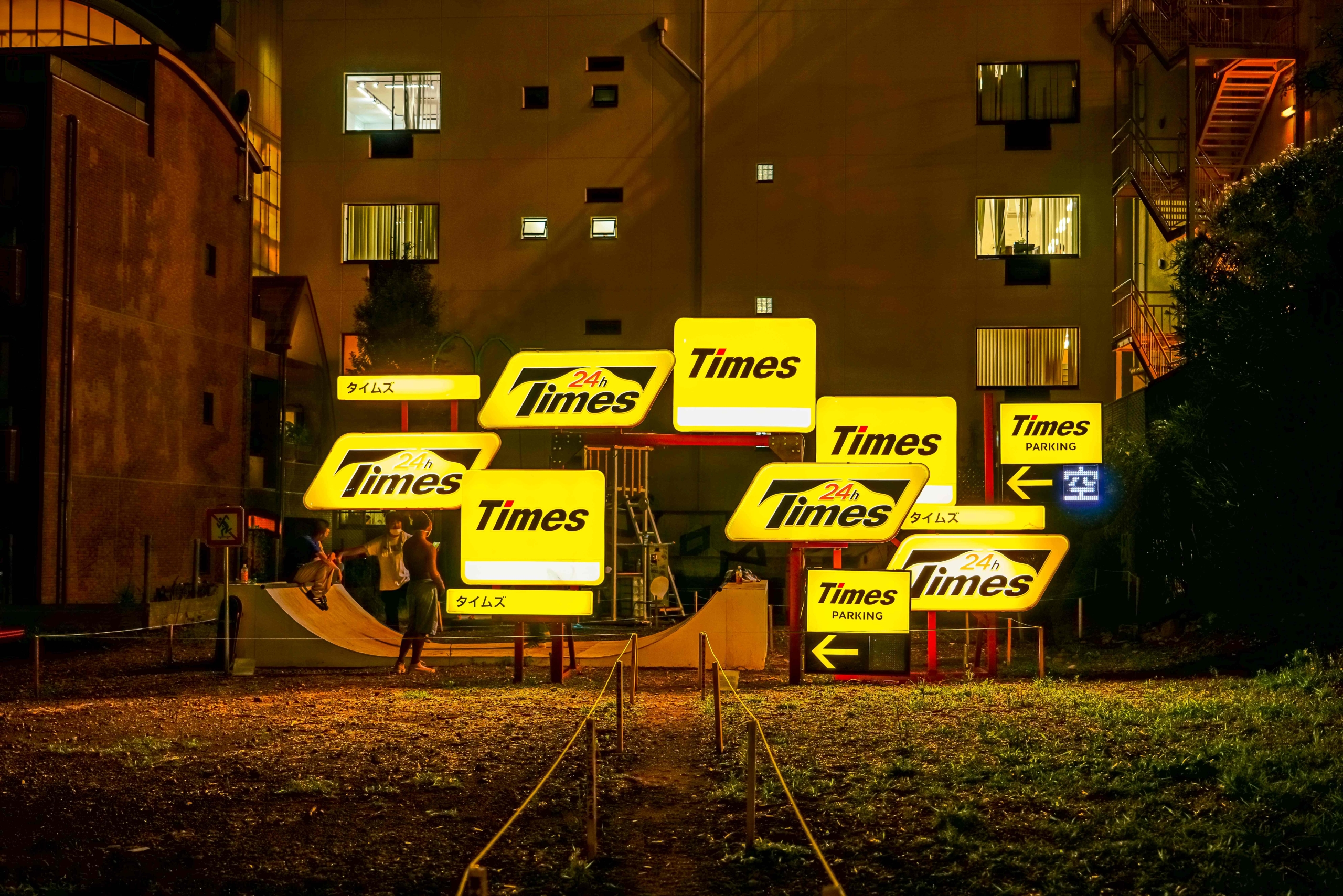
We are not all skateboarders, but one member is a graffiti artist and all of us have street-art practice. That outsider vantage point lets us appreciate skateboarding’s appeal and interpret it more freely. When graffiti becomes a central subject, our own subjective viewpoint can grow strong and introduce bias. Skateboarding is not only a sport; it is a street philosophy. Skilled skateboarders can be thinkers, artists and community leaders, and watching and listening to them gives us inspiration.
From guerrilla to long-term research
Z: You were known for guerrilla interventions early on, and later shifted to long-term local research. Does that shift from “guerrilla” tactics to long-term work reflect a deeper thinking about cities and institutions?
SC: Many of our projects critique the centralized systems of the city and involve forms of action. When we work outside urban centers, we must research the historical relationship between the city and the area before starting. In other words, art practice outside the city requires a long-term approach; working inside the city and maintaining a critical view of it is relatively easier.
For example, in our recent solo show at wamono art we produced a new Hong Kong–themed work in a relatively short time. Some projects take years, others come together faster.
Institutions as public space
Z: Your project sites range from skate parks to museums to disaster-affected terrain. How do these different spaces reconnect and register in your practice? When “publicness” meets institutional art space, what tensions and possibilities arise, and how does that strategy challenge museum function and audience experience?
SC: Historically, museums have validated certain authorities as “art” and excluded others. We were encouraged when a young curator who had been thinking about transforming museums contacted us after the Noto Peninsula earthquake, and used the moment to put those ideas into practice.
In Kanazawa’s 21st Century Museum of Contemporary Art, the creation of a skate park aimed to open the museum to a broader public. The city has many skateboarders and many families who visit museums. During the exhibition, local skateboarders came almost every day, and for many children the skate park functioned like a public playground. The graffiti on the walls evolved over time. We think this kind of practice is still rare in Japanese museums.
We also think that framing street and museum as a strict binary is an outdated postmodern view. Many museums in Japan are publicly funded and can function like a public square; as parts of the city they should be open to people. The idea of the white cube as a neutral, sterile environment is also outdated; every museum has local character and a specific political environment. Whether in the street or in a museum, each space has its personality, and the important task is finding the most suitable form of expression for a given place and moment.
Side Core art in Hong Kong
Z: How will the works you show at Art Central 2026 engage with Hong Kong’s urban context? What street-culture elements or spatial qualities in Hong Kong caught your attention during your research?
SC: The works we showed at Art Central 2026 were collages of Japanese construction and street signs originally used in public space, which we see as symbols of a city in flux. In a sense they connect street context and the art-fair context. While walking in Hong Kong we noticed the entire city is constantly under development, and similar signs appear everywhere, much as in Japan. Going forward, we want to produce a collage that blends Hong Kong and Japanese architectural signage.
Globalization and the street
Z: With globalization and digitization, how do you see the concept of “the street” evolving, and what role will artists play?
SC: Regarding street culture, we have heard that graffiti blossomed globally after the COVID-19 pandemic. In Tokyo, urban redevelopment has reduced the number of graffiti sites, while in Osaka graffiti seems to be increasing. We believe street expressions will continue to expand over the next decade, and that growth often correlates with broader social instability. It is important to keep generating ideas and taking action even in difficult times, and we must listen to and trust the potential of younger generations, regardless of age.
SIDE CORE solo exhibition “under city”
Dates: March 21 to May 16, 2026
Hours: Saturday, 12 p.m. to 6 p.m.; Monday through Friday by appointment only; closed Sundays and public holidays
Location: wamono art, 10/F, Block A, Tel: 49 Tak Lee Industrial Building, Wong Chuk Hang Road, Wong Chuk Hang (a neighborhood on Hong Kong Island’s south side)
*To book, WhatsApp +852 6822 2962
Method and medium
Z: Your work moves across media: street interventions, video, sound installation and ceramics. Does that variety arise from the needs of each project, or is it a deliberate challenge to disciplinary boundaries? Do different media change how you express “publicness”?
SC: We embrace cross-media practice. Ideally, we do not start by choosing a medium; we start from an idea and then select the medium. The art world itself is organized by medium: painting often dominates the market, while video and installation are more common in museums. Breaking that structure is difficult, but we believe it is necessary.
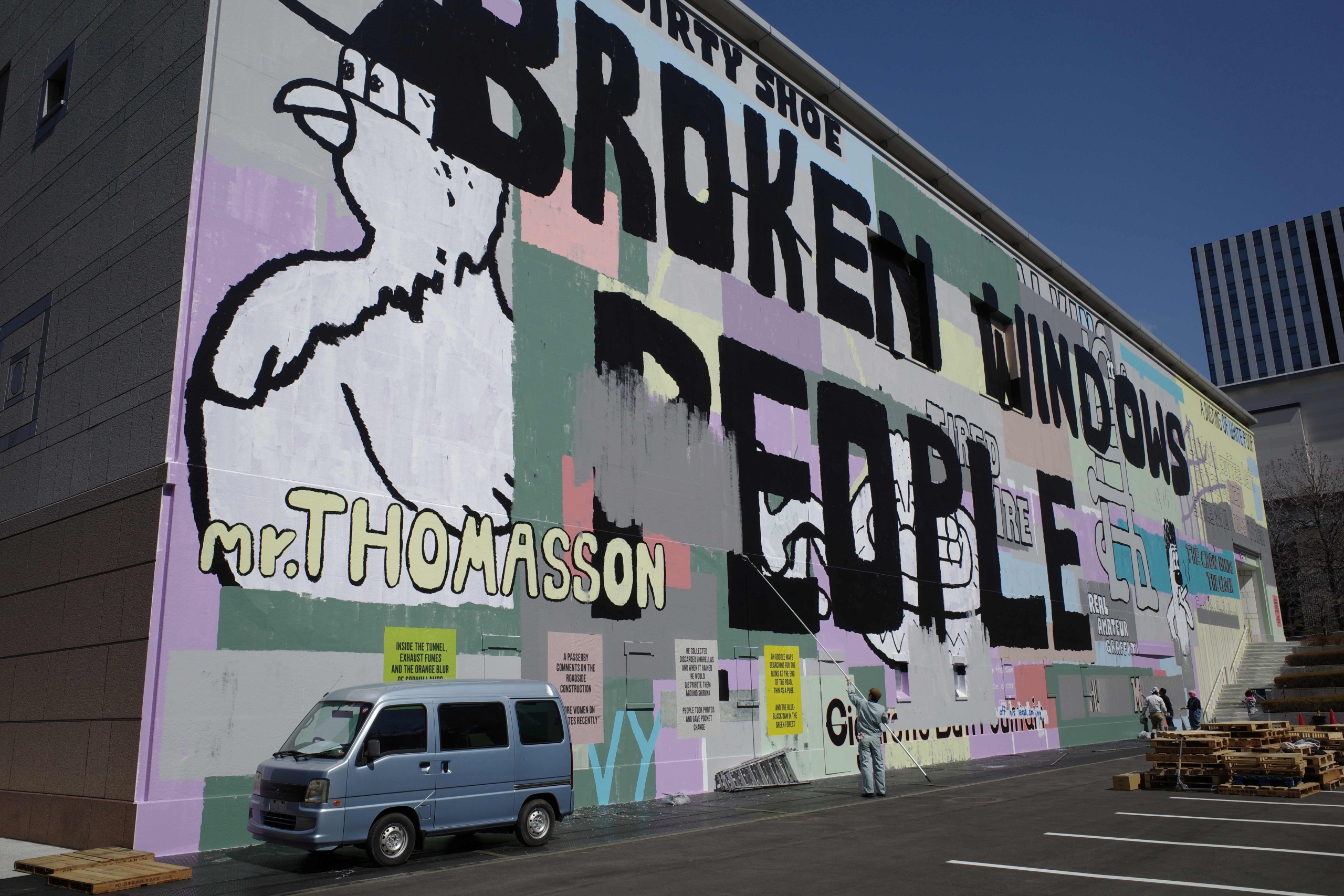
Z: When you make work after a disaster, how do you convert that experience into artistic material? What can art do and not do in the face of catastrophe, and what challenges have you faced?
SC: Not every member would put it this way, but we think art and philosophy are ways of thinking and acting that anyone can use. Making work and staging exhibitions are how we share those approaches. When normal life and action are disrupted, we try to adopt different ideas and behaviors to address problems. Those ideas often come from diverse philosophies and artistic practices, including street culture, which grew from marginalized communities in the United States and spread through globalization into an international network. Small-scale local practices and ideas still circulate through communities and online, and we draw from what is meaningful to us and fold it into daily life.
Street as bridge
Z: Your theme of the ‘‘street” is described as a bridge connecting regions and values. One work, “time gate”, was shown in a temporary park with a skate area. From Japan to Hong Kong, how has skateboarding, as a global street-culture sign, become a medium for understanding the city, and what symbolic role does it play in your practice?
SC: We heard Hong Kong has an active skateboard scene, though skating can still be difficult in central districts. For us, street culture is a way to look at urban space from a distinct angle, to intervene and leave traces, and to communicate through those actions. Skateboarding vividly embodies that process.
We are not all skateboarders, but one member is a graffiti artist and all of us have street-art practice. That outsider vantage point lets us appreciate skateboarding’s appeal and interpret it more freely. When graffiti becomes a central subject, our own subjective viewpoint can grow strong and introduce bias. Skateboarding is not only a sport; it is a street philosophy. Skilled skateboarders can be thinkers, artists and community leaders, and watching and listening to them gives us inspiration.
From guerrilla to long-term research
Z: You were known for guerrilla interventions early on, and later shifted to long-term local research. Does that shift from “guerrilla” tactics to long-term work reflect a deeper thinking about cities and institutions?
SC: Many of our projects critique the centralized systems of the city and involve forms of action. When we work outside urban centers, we must research the historical relationship between the city and the area before starting. In other words, art practice outside the city requires a long-term approach; working inside the city and maintaining a critical view of it is relatively easier.
For example, in our recent solo show at wamono art we produced a new Hong Kong–themed work in a relatively short time. Some projects take years, others come together faster.
Institutions as public space
Z: Your project sites range from skate parks to museums to disaster-affected terrain. How do these different spaces reconnect and register in your practice? When “publicness” meets institutional art space, what tensions and possibilities arise, and how does that strategy challenge museum function and audience experience?
SC: Historically, museums have validated certain authorities as “art” and excluded others. We were encouraged when a young curator who had been thinking about transforming museums contacted us after the Noto Peninsula earthquake, and used the moment to put those ideas into practice.
In Kanazawa’s 21st Century Museum of Contemporary Art, the creation of a skate park aimed to open the museum to a broader public. The city has many skateboarders and many families who visit museums. During the exhibition, local skateboarders came almost every day, and for many children the skate park functioned like a public playground. The graffiti on the walls evolved over time. We think this kind of practice is still rare in Japanese museums.
We also think that framing street and museum as a strict binary is an outdated postmodern view. Many museums in Japan are publicly funded and can function like a public square; as parts of the city they should be open to people. The idea of the white cube as a neutral, sterile environment is also outdated; every museum has local character and a specific political environment. Whether in the street or in a museum, each space has its personality, and the important task is finding the most suitable form of expression for a given place and moment.
Side Core art in Hong Kong
Z: How will the works you show at Art Central 2026 engage with Hong Kong’s urban context? What street-culture elements or spatial qualities in Hong Kong caught your attention during your research?
SC: The works we showed at Art Central 2026 were collages of Japanese construction and street signs originally used in public space, which we see as symbols of a city in flux. In a sense they connect street context and the art-fair context. While walking in Hong Kong we noticed the entire city is constantly under development, and similar signs appear everywhere, much as in Japan. Going forward, we want to produce a collage that blends Hong Kong and Japanese architectural signage.
Globalization and the street
Z: With globalization and digitization, how do you see the concept of “the street” evolving, and what role will artists play?
SC: Regarding street culture, we have heard that graffiti blossomed globally after the COVID-19 pandemic. In Tokyo, urban redevelopment has reduced the number of graffiti sites, while in Osaka graffiti seems to be increasing. We believe street expressions will continue to expand over the next decade, and that growth often correlates with broader social instability. It is important to keep generating ideas and taking action even in difficult times, and we must listen to and trust the potential of younger generations, regardless of age.
SIDE CORE solo exhibition “under city”
Dates: March 21 to May 16, 2026
Hours: Saturday, 12 p.m. to 6 p.m.; Monday through Friday by appointment only; closed Sundays and public holidays
Location: wamono art, 10/F, Block A, Tel: 49 Tak Lee Industrial Building, Wong Chuk Hang Road, Wong Chuk Hang (a neighborhood on Hong Kong Island’s south side)
*To book, WhatsApp +852 6822 2962
Side Core art turned the street into a method, not just a setting, at Art Central’s Central Stage program, where the Tokyo collective’s appearance read less like a booth and more like a public reexamination of what “publicness” can be.
The collective, founded in 2012 in Tokyo by Sakue Takasu (高須咲恵), Tetsu Matsushita (松下徹) and Taishi Nishihiro (西広太志), with video director Kazuyoshi Baramoto (播本和宜), has long used street culture as a working methodology.
From skate parks and graffiti walls to urban gaps and the Kanazawa 21st Century Museum of Contemporary Art, the group brings the street into institutional space and, at the same time, disassembles institutions so they might be reimagined as public commons.
This report follows the group from Art Central into their studio and practice.
Z: ZTYLEZ
SC: SIDE CORE
Z: The name SIDE CORE itself suggests a tension between margin and center. Looking back to your founding in 2012, what led you naturally toward a practice rooted in street culture? Can you describe the original impetus for forming the group and the drive behind it?
SC: For those of us born in the 1980s, an interest in street culture was practically natural. There was no single dramatic turning point, but we arrived at a way of working that sits between contemporary art and street practice. The key moment that pushed us to think more deeply about street culture was the Great East Japan Earthquake, when infrastructure collapsed and urban systems failed. That experience pushed many of us to take action in public space.
Z: The members come from different backgrounds. How did you meet and develop a stable collaborative practice?
SC: Takasu, known as Jango, and Matsushita, known as Tohry, entered art school the same year though in different departments. We met Diego through a mutual friend at a book fair; he was an active graffiti artist at a time when graffiti artists rarely organized independent exhibitions. He also had a strong understanding of urban planning. He began contributing to SIDE CORE’s exhibitions regularly from 2017 onward.
Z: How do you maintain the group’s working model?
SC: A central feature of our practice is a loose structure. We do not fix roles; project planning and production happen through discussion. Each member also pursues individual work and belongs to different communities. We see continuous dialogue as the key to collective creation.
Method and medium
Z: Your work moves across media: street interventions, video, sound installation and ceramics. Does that variety arise from the needs of each project, or is it a deliberate challenge to disciplinary boundaries? Do different media change how you express “publicness”?
SC: We embrace cross-media practice. Ideally, we do not start by choosing a medium; we start from an idea and then select the medium. The art world itself is organized by medium: painting often dominates the market, while video and installation are more common in museums. Breaking that structure is difficult, but we believe it is necessary.
Z: When you make work after a disaster, how do you convert that experience into artistic material? What can art do and not do in the face of catastrophe, and what challenges have you faced?
SC: Not every member would put it this way, but we think art and philosophy are ways of thinking and acting that anyone can use. Making work and staging exhibitions are how we share those approaches. When normal life and action are disrupted, we try to adopt different ideas and behaviors to address problems. Those ideas often come from diverse philosophies and artistic practices, including street culture, which grew from marginalized communities in the United States and spread through globalization into an international network. Small-scale local practices and ideas still circulate through communities and online, and we draw from what is meaningful to us and fold it into daily life.
Street as bridge
Z: Your theme of the ‘‘street” is described as a bridge connecting regions and values. One work, “time gate”, was shown in a temporary park with a skate area. From Japan to Hong Kong, how has skateboarding, as a global street-culture sign, become a medium for understanding the city, and what symbolic role does it play in your practice?
SC: We heard Hong Kong has an active skateboard scene, though skating can still be difficult in central districts. For us, street culture is a way to look at urban space from a distinct angle, to intervene and leave traces, and to communicate through those actions. Skateboarding vividly embodies that process.
We are not all skateboarders, but one member is a graffiti artist and all of us have street-art practice. That outsider vantage point lets us appreciate skateboarding’s appeal and interpret it more freely. When graffiti becomes a central subject, our own subjective viewpoint can grow strong and introduce bias. Skateboarding is not only a sport; it is a street philosophy. Skilled skateboarders can be thinkers, artists and community leaders, and watching and listening to them gives us inspiration.
From guerrilla to long-term research
Z: You were known for guerrilla interventions early on, and later shifted to long-term local research. Does that shift from “guerrilla” tactics to long-term work reflect a deeper thinking about cities and institutions?
SC: Many of our projects critique the centralized systems of the city and involve forms of action. When we work outside urban centers, we must research the historical relationship between the city and the area before starting. In other words, art practice outside the city requires a long-term approach; working inside the city and maintaining a critical view of it is relatively easier.
For example, in our recent solo show at wamono art we produced a new Hong Kong–themed work in a relatively short time. Some projects take years, others come together faster.
Institutions as public space
Z: Your project sites range from skate parks to museums to disaster-affected terrain. How do these different spaces reconnect and register in your practice? When “publicness” meets institutional art space, what tensions and possibilities arise, and how does that strategy challenge museum function and audience experience?
SC: Historically, museums have validated certain authorities as “art” and excluded others. We were encouraged when a young curator who had been thinking about transforming museums contacted us after the Noto Peninsula earthquake, and used the moment to put those ideas into practice.
In Kanazawa’s 21st Century Museum of Contemporary Art, the creation of a skate park aimed to open the museum to a broader public. The city has many skateboarders and many families who visit museums. During the exhibition, local skateboarders came almost every day, and for many children the skate park functioned like a public playground. The graffiti on the walls evolved over time. We think this kind of practice is still rare in Japanese museums.
We also think that framing street and museum as a strict binary is an outdated postmodern view. Many museums in Japan are publicly funded and can function like a public square; as parts of the city they should be open to people. The idea of the white cube as a neutral, sterile environment is also outdated; every museum has local character and a specific political environment. Whether in the street or in a museum, each space has its personality, and the important task is finding the most suitable form of expression for a given place and moment.
Side Core art in Hong Kong
Z: How will the works you show at Art Central 2026 engage with Hong Kong’s urban context? What street-culture elements or spatial qualities in Hong Kong caught your attention during your research?
SC: The works we showed at Art Central 2026 were collages of Japanese construction and street signs originally used in public space, which we see as symbols of a city in flux. In a sense they connect street context and the art-fair context. While walking in Hong Kong we noticed the entire city is constantly under development, and similar signs appear everywhere, much as in Japan. Going forward, we want to produce a collage that blends Hong Kong and Japanese architectural signage.
Globalization and the street
Z: With globalization and digitization, how do you see the concept of “the street” evolving, and what role will artists play?
SC: Regarding street culture, we have heard that graffiti blossomed globally after the COVID-19 pandemic. In Tokyo, urban redevelopment has reduced the number of graffiti sites, while in Osaka graffiti seems to be increasing. We believe street expressions will continue to expand over the next decade, and that growth often correlates with broader social instability. It is important to keep generating ideas and taking action even in difficult times, and we must listen to and trust the potential of younger generations, regardless of age.
SIDE CORE solo exhibition “under city”
Dates: March 21 to May 16, 2026
Hours: Saturday, 12 p.m. to 6 p.m.; Monday through Friday by appointment only; closed Sundays and public holidays
Location: wamono art, 10/F, Block A, Tel: 49 Tak Lee Industrial Building, Wong Chuk Hang Road, Wong Chuk Hang (a neighborhood on Hong Kong Island’s south side)
*To book, WhatsApp +852 6822 2962