


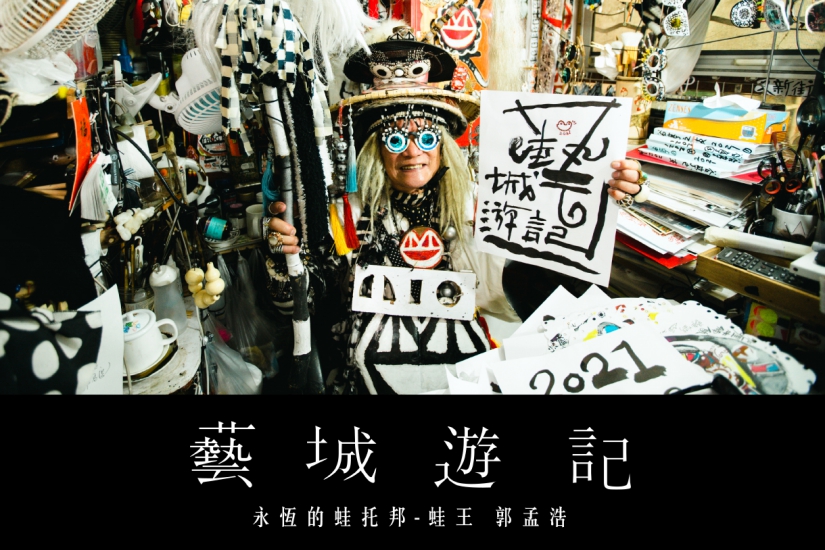
Frog King Kwok has spent five decades testing the edges of art, and at 74 he still shows up to exhibitions in full frog costume to lead performances and community projects.
Known for turning everyday objects into sculptures and live experiments, Kwok Mang-ho (郭孟浩), who is widely known as Frog King, now lives quietly in the countryside of Yuen Long, though he remains deeply connected to Hong Kong’s art scene.
On the day we visited, he arrived in full frog regalia: thick knit sleeves, a wig and hat, layered necklaces, frog eye glasses, and a walking stick. He guided us through what he calls his “Frog Museum,” showed us a new studio in Ngau Tam Mei (a village in Yuen Long), and staged an impromptu, large scale experiment that mixed water, ink and fire. He worked through the heat without complaint, smiling as he said, “It is another chance to play.”
“I am more than performance art,” Frog King Kwok said
Kwok has long been labeled a performance artist, but he rejects being confined to a single category. He traces his work back to radical experiments in the late 1970s, including an early plastic bag installation at Tiananmen when China began opening up. Scholars and curators later described that action as one of the first documented performance art works in China, but Kwok says labels miss the point.
“I did many performances in the 1970s, so people call them performance art, but I also make sculpture, installation and experiments,” he told us. “What I want is for viewers to see the ideas behind the action.”
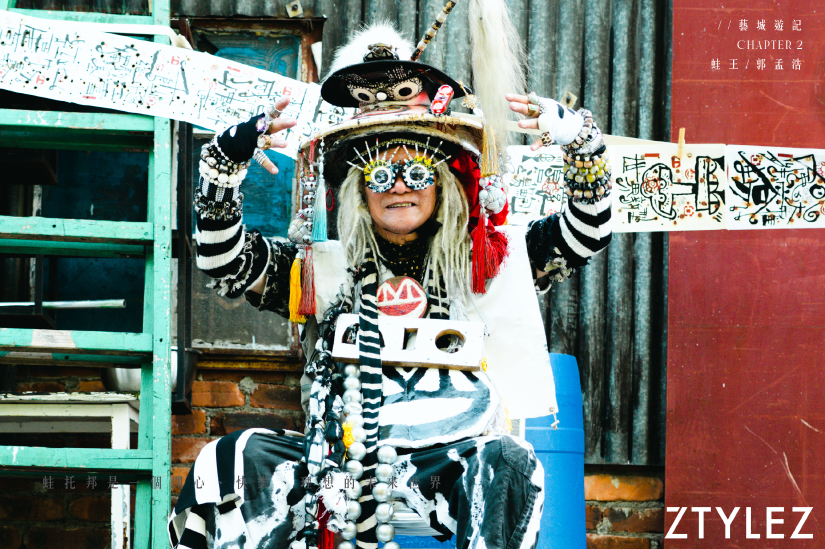
For Kwok, nothing is off limits as a material: plastic bags, paper, bamboo, air, water and fire all become media, and at times his own body is the canvas. He rejects the idea that his costume exists only to attract attention, saying the outfit and the Frog King persona are ways to express larger concepts.
Art as a breathing life form
He describes his work as a “breathing life form,” objects reanimated through touch, performance and intervention. “Any object can become a work if you do not let convention limit you,” he said, noting that his practice is as much philosophical as it is practical.
Kwok calls his aesthetic “mixed unity,” a principle that finds order within apparent disorder. Large installations may look chaotic, but he said they follow an internal logic shaped by years of experimentation.
Interaction is a pillar of his work. For years he has run the Frog Eyes Project, inviting people to wear the frog glasses he paints, photographing them and celebrating the moment of play. “Put the glasses on and you become frogified,” he said, laughing. The portraits gather people of different backgrounds into a shared, joyful experiment.
Paper, ink and a public ritual
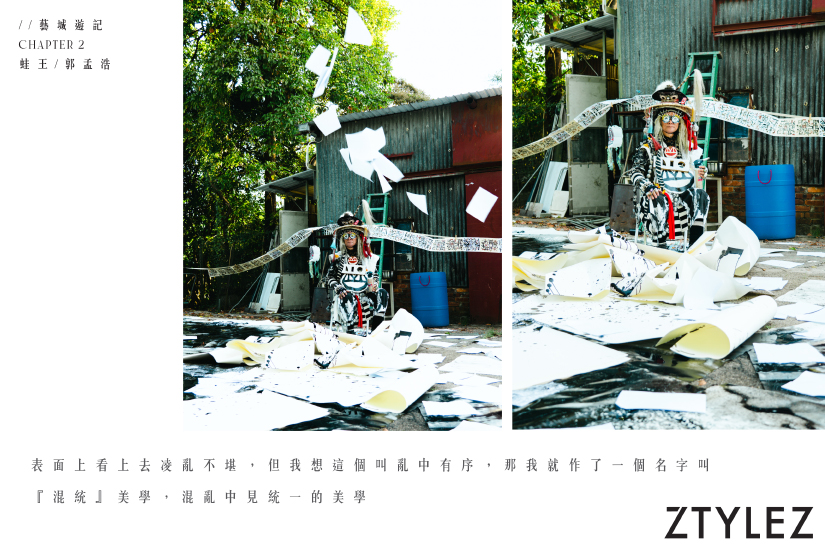
Outside his new studio in Ngau Tam Mei, Kwok staged a spontaneous ink performance to illustrate his ideas about creativity. He scattered old painted film sheets across sand and gravel, laid large sheets of paper on the ground, then splashed ink and asked us to throw stacks of A4 paper into the air.
The airborne sheets fell back to the ground smudged with ink. He sprayed water to blur the marks, then used a blowtorch to burn the remains into ash. The ritual moved from playful to violent then to quiet, and in the end the ruined paper returned the act to pure ink.
“Paper is the carrier of modern creativity,” he explained. “We throw it up so creativity can fly, and when the paper falls stained by ink it mirrors my practice: even in playful destruction the work returns to ink wash painting.”

Kwok emphasized the spontaneity of such experiments. “The concept may be the same, but every trial is different because people, materials and environment change,” he said. He acknowledged the work can be messy and time consuming to clean, but said the effort is part of the practice.
Mentors, exile and return
Kwok credits the late ink master Lui Shou-kwan (呂壽琨) with shaping his approach. He described studying class tapes of his teacher in New York and feeling renewed by the lessons long after his mentor died.
He left Hong Kong for New York and lived there for 15 years, then returned in 1995. “I learned much from the previous generation in Hong Kong,” he said, adding that his work now aims to give back by engaging community and inspiring younger artists.
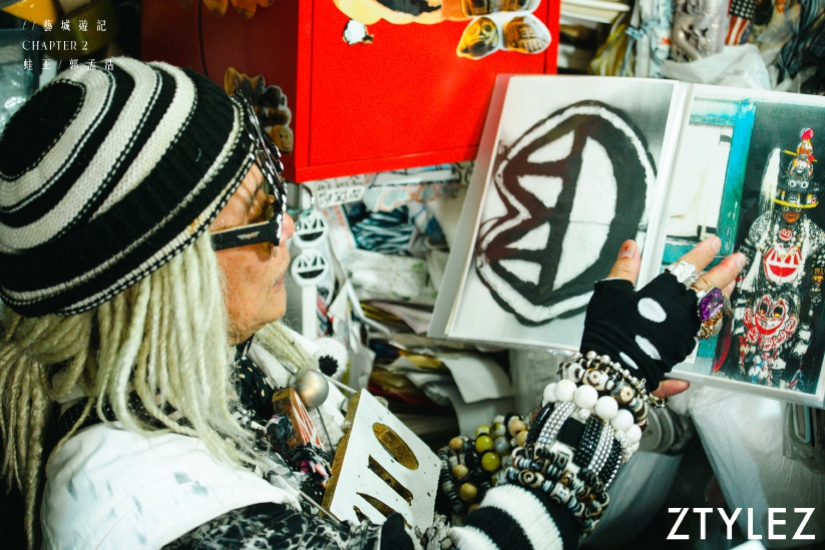
Over the decades his once dismissed pieces have found a market, and he has taken part in thousands of projects internationally. He continues to appear at major Hong Kong events, including art fairs and museum reopenings, and at the opening of the M+ museum.
Community first, commerce second
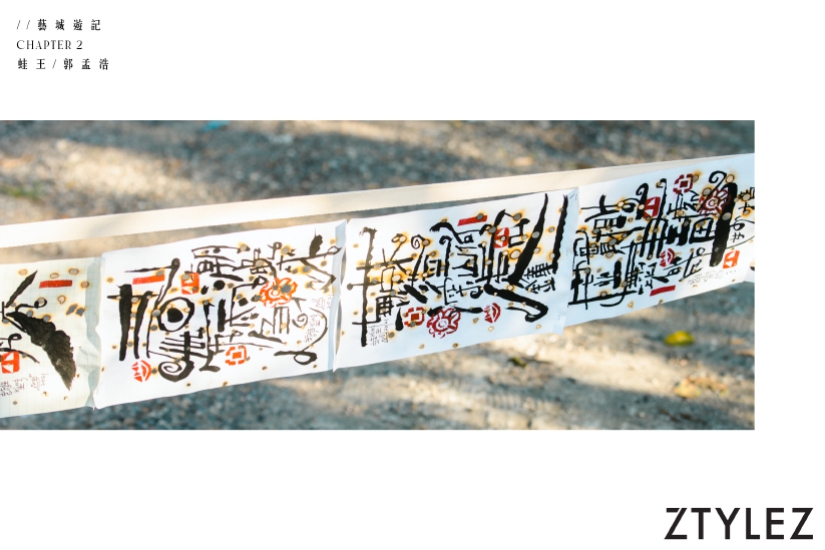
Despite recognition, Kwok parcels out work freely. He recently launched a local project in Yuen Long called “Friends of Kuk Ting Street,” inviting neighbors to wear frog glasses and receive personalized inked name cards created by him. Neighbors have nicknamed him the group’s president.
We asked whether giving work away conflicts with gallery and auction norms. “In theory rarity makes things valuable, and selling expensive works is part of commerce,” he said. “But if a work has inner substance and philosophical meaning, its value cannot be measured only by money.”
He describes his ongoing public practice as a form of cultural inheritance. “If I keep planting seeds, someday a tree will grow and new talents will emerge,” he said. He called his work an “intangible cultural asset” and said he sees himself as a custodian rather than a celebrity.
Frog Utopia
For Kwok the goal is simple. He invites people to enter his “Frog Utopia,” a playful imagined world he builds with costumes, glasses and gatherings. “Art is hard play,” he said. “You must be willing to die many times and then be reborn to make something with depth.”
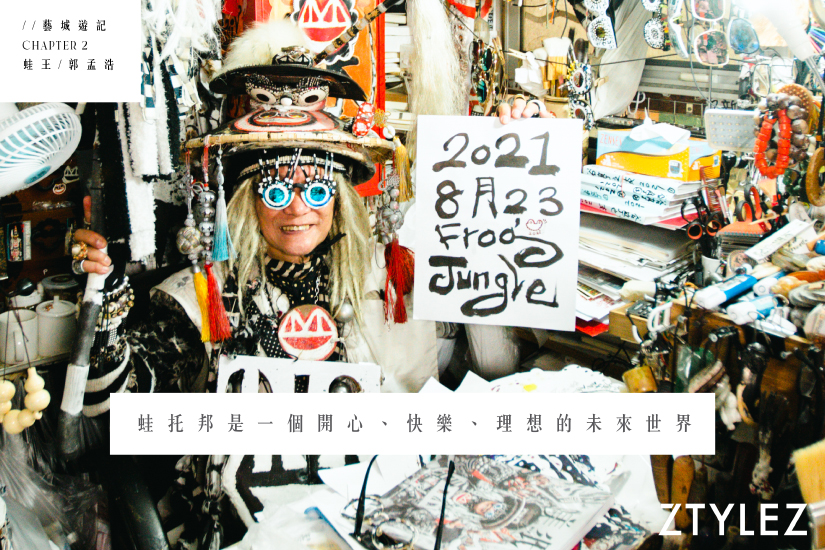
He still moves slowly with a walking stick, but he carries a camera, frog glasses and ink into the community. “If I can be a happy frog, that is enough,” he said. He joked about a lifetime goal of producing nine million works and smiled as we drove back to his home in Ping Shan (a historic area in Yuen Long).
When Kwok’s Frog Jungle relocates, he said the important thing is not the place but the impulse to create joy. “The Frog Utopia does not disappear. It is planted in the soil of Hong Kong,” he said, and added that his practice leaves traces everywhere he has worked.
Executive Producer: Angus Mok
Producer: Vicky Wai
Editor: Ruby Yiu
Videography: Anson Chan, Andy Lee
Photography: Anson Chan
Video Editor: Anson Chan, Andy Lee
Designer: Tanna Cheng
Special Thanks: Frog King Kwok