



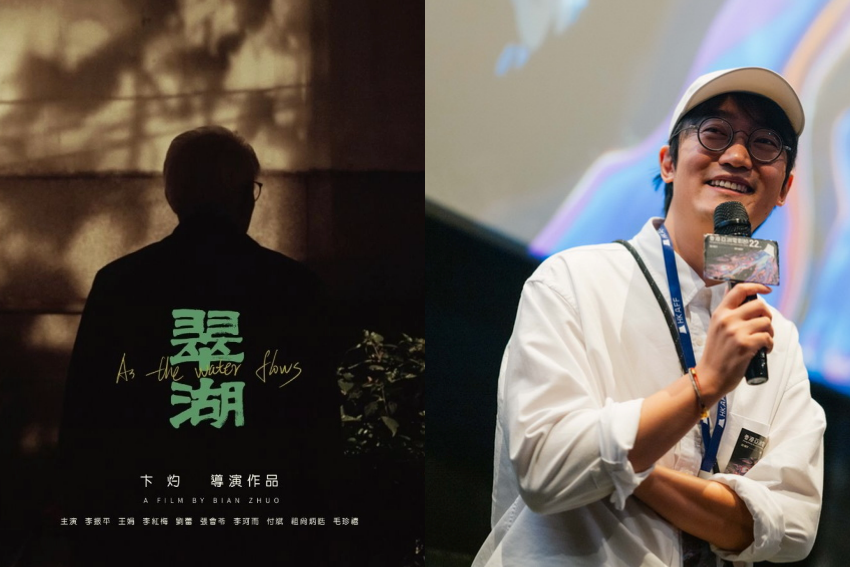
Director Bian Zhuo (卞灼)’s feature debut, “As the Water Flows” (翠湖), premiered recently at the Hong Kong Broadway Cinematheque (香港百老匯電影中心) during the Easter holiday, using Kunming’s Green Lake as a setting to examine family memory, unspoken emotion, and the slow erosion of intimate bonds.
“As the Water Flows” begins with a widower whose life falls into near stillness after his partner’s death. He is often seen alone on the lake, repeating a modest daily routine while memories surface: a youthful romance that did not endure because of family pressure, three daughters who appear to have stable lives yet remain distant, and longtime friends who gradually leave. The film does not build these moments into overt dramatic confrontations, but rather composes a sustained condition in which relationships persist without returning to their former shape.
The casting avoids a conventional star lineup and favors naturalistic performances. The actor who plays the widower approaches the role with great restraint, conveying feeling through small gestures and pauses. The three daughters represent different life stages; variations in tone and physical distance underline everyday strains in family dynamics.

“As the Water Flows” won Best Film in the Asian New Talent Competition at the Shanghai International Film Festival, with the jury praising how the film “starts from the everyday and presents the flow of family time.” It later screened at the Vancouver International Film Festival, and it earned the Asia New Director Award at the Hong Kong Asian Film Festival. The Hong Kong premiere and limited run were held at the Broadway Cinematheque, marking the film’s first local release.

The premiere included a post-screening discussion with Bian and Xiong Jingming (熊景明), author of The Elders’ Stories. Bian said his creative impulse came from family writings and records left by older relatives, the emotions that were never voiced in life but preserved in text. He said he wanted to transform those unsaid elements into images, so audiences can feel them rather than have characters explain them directly.

Xiong drew on his experience as a writer to discuss the prior generation’s restraint in emotional expression, and the long-standing silences that shape family life. Their exchange expanded the film’s frame from Kunming’s city memories to broader family experiences, opening interpretive contexts for viewers.

For the Hong Kong screenings, organizers distributed a special local poster and arranged a signing session. The venue was modest in scale, but responses were warm. Audience members asked questions in Mandarin, and others shared impressions in Cantonese, with the language shift creating a natural, rather than distancing, exchange.

After the screening, many viewers lingered to discuss family relationships, to recall personal memories, or simply to stand quietly. The lights had come on, but the viewing state seemed to continue. That pause reflected the film’s pacing: the experience does not end when the picture does.

How distance forms within family relationships
“As the Water Flows” focuses less on discrete events and more on how relationships consolidate over long stretches of time. The tensions between the widower and his three daughters do not stem from a single confrontation. Rather, absence, misunderstanding, and silence build up over years, making repair increasingly difficult.

The film also sensitively examines pressures across generations. The older generation grapples with loneliness and the passage of time. Middle-aged children juggle work and family obligations, with emotion and duty often out of balance. Younger family members display growing detachment in their interactions. These pressures are not spelled out; they seep into everyday life.
Emotions are not heightened for effect. Instead, conflicts remain low in intensity. The characters care for one another, but life pulls them in different directions and the rhythm of conversation is lost.
How dialogue builds relationship while revealing problems
The film relies on long takes and minimal directorial intervention, allowing characters to move naturally within the frame. Viewers cannot depend on editing to guide interpretation, so they enter characters’ emotional states by observing.
Dialogue carries weight. Characters talk about daily life and the past, and conversations often avoid the core. Some people try to keep things simple, skim over the past, or limit themselves to basic concern for each other, but reserve remains apparent in tone.

At times, talk functions as maintenance rather than understanding. Characters respond without truly addressing one another’s emotions, and exchanges stay on the surface. The film’s use of conversational maintenance recalls the spirit of Richard Linklater’s “Before” trilogy, but “As the Water Flows” leans toward stasis; speech continues without bringing people closer, and language can emphasize distance.
How image and light shape emotional distance
Bian’s use of light is similarly restrained. Interior scenes favor natural light that seeps from windows, leaving figures often half lit and half in shadow, producing an unstable emotional tone. Light does not fully reveal faces, and shadows keep expressions subdued.

Outdoors, reflections on Green Lake and the moist air give images a soft, slightly hazy quality. Figures sometimes dissolve into the light, making boundaries with the background indistinct and echoing uncertainty in relationships.
The director frequently uses backlight and side light to obscure facial detail, revealing only contours or partial expressions. That choice prevents viewers from fully reading emotional states, inviting them to fill in gaps and widening the distance between audience and character.
Light and shadow are not decoration. They shift with the characters’ inner lives, and when relationships cannot be explained, the image does not rush to explain either.
When language cannot reach feeling
As conversation continues, language reveals its limits. Characters speak to sustain bonds, but the most important parts remain unexpressed.
At times, tone settles into near acceptance. The past is no longer questioned and emotions are not unpacked. Dialogue retains only essentials. Silence ceases to be empty; it becomes a form of relationship.

Close-ups are used sparingly. When the camera does approach, there is no emotional eruption, only pauses and hesitations. Those moments make characters feel authentic; they do not fail to want to express themselves, they simply do not know how.
The ending offers time, not resolution
“As the Water Flows” ends without tidy answers. Relationships remain unrepaired, and conflicts are not resolved.
Small shifts occur. The change is not reconciliation so much as recognition. Characters become aware of, and sometimes accept, the distances between them. Relationships are returned to time, and they continue to exist.

Some audience members at the Hong Kong screenings said they felt a familiar sense of stasis even if they had never been to Kunming. Others compared Green Lake to Hong Kong, noting similar emotional structures across different cities.

“As the Water Flows” does not pander to viewers. Its pace is slow, its emotions restrained, and it lacks a clear dramatic climax. Viewers must adapt to near stillness, shifting attention from plot progression to the spaces between characters, to the pauses in conversation, and to what remains unspoken. Some impressions take hold only after leaving the theater, when moments, tones, or small silences resurface in daily life.
The film does not hurry to sort relationships, nor does it offer emotional catharsis. It places characters back into time and allows their unfinished parts to persist. That incompletion, in turn, stays with the audience.
Playing during the Easter holiday, “As the Water Flows” is running in a limited engagement at the Hong Kong Broadway Cinematheque as an alternative viewing rhythm for the holiday period. For screening times and ticket information, see the Broadway Cinematheque official site: https://www.cinema.com.hk/hk/movie/682