


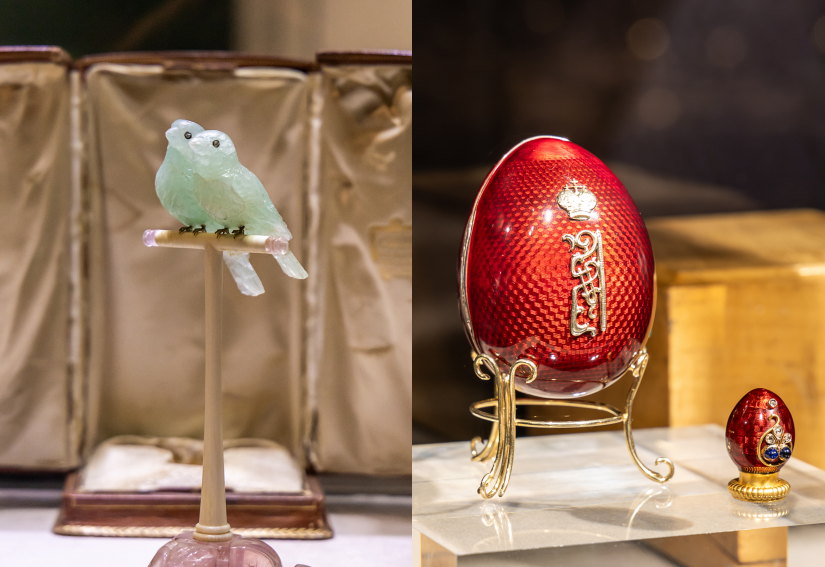
Liang Yizang Museum (兩依藏博物館) and Palais Royal Hong Kong are presenting “Fabergé and Cartier: Different Worlds, Shared Excellence,” from Feb. 26 to Sept. 1, 2026, on Hollywood Road in Sheung Wan, Hong Kong, showcasing how the two houses shaped jewelry aesthetics around the turn of the 20th century.
Palais Royal Hong Kong founder Gilles Zaluyan said, “Fabergé set an uncompromising global standard.” By 1900 Fabergé was the Russian imperial court jeweler, unrivaled in influence, while Cartier pursued a similar royal clientele from Paris.
Two Households in Quiet Competition, Five Must See Highlights
The exhibition brings together 105 objects, including Cartier clocks and jewelry, and powder boxes and silverware from the Liang Yizang Museum permanent collection. The works trace a story of innovation and continuity, showing how Fabergé’s Russian opulence and Cartier’s French modernism fed one another to help launch the international decorative arts movement.
1. “The Tsarevich” Easter Egg, 1905, Fabergé

In 1905, Tsar Nicholas II commissioned an Easter egg for his long awaited heir, Alexei, beginning a series of imperial gifts known for gems, enamel, and intricate mechanisms. Fabergé eggs often contained portraits and symbolic surprises that embodied paternal affection and dynastic continuity. Notable imperial eggs include the 1893 “Caucasus,” the 1895 “Rosebud,” the 1905 “Tsarevich,” the 1910 “Colonnade,” the 1914 “Mosaic,” and the 1916 “Steel Military.” The 1912 egg was altered when the heir fell ill, clarifying his formal title as Tsesarevich, and the intended “Constellation” piece for his tenth birthday was never completed. Scholarship now recognizes the 1905 egg as the heir Alexei’s first imperial Easter egg, a witness to the last years of imperial pageantry and family memory.
The 1905 “Tsarevich” egg features bright red enamel, glittering gemstones, and refined metalwork that exemplify Fabergé’s hallmarks. Its surface bears the heir’s personal monogram, and inside a smaller egg holds the chrism oil used at his baptism. The curatorial team has placed this contested work at the center of the exhibition to prompt public engagement with questions of authenticity, value, and the nature of art.
2. Orchid Study in a Glass Dome, 1907, Cartier

Cartier’s flowering plant sculptures are among the exhibition’s highlights. This orchid study stands about 26.8 centimeters (10.6 inches) tall and is carved from agate, enamel, sapphire, gold, bronze, and glass, preserving a single orchid as if time had stopped.
Carved from natural hardstone, the blue flower seems to dance against its green leaves. Petals are shaded with delicate enamel, stems are elegantly rendered, and gemstone accents catch the light. The box bears the Cartier logo and two hardstone flies that add a whimsical touch. The piece reflects Cartier’s early exploration of naturalism, and its transformation of haute jewelry techniques into decorative art. The orchid symbolizes purity and rarity, and the work echoes early 20th century Europe’s fascination with exotic plants, marrying Russian naturalism and French refinement.
3. Dashboard Gauges, 1907, Cartier

This 1907 Cartier piece combines fine enamel work and geometric design, showing how Cartier fused utility and artistry to create luxurious accessories for early automobile enthusiasts. The object reflects how Cartier, inspired in part by Fabergé, charted its own inventive course.
Made around 1907, the “Dashboard Gauges” desk clock is crafted from enamel, gold, and silver, and expresses the early decorative arts fusion of mechanical aesthetics and meticulous craftsmanship. Its twin dial design echoes contemporary automobile gauges, turning a symbol of the machine age into an elegant tabletop object. The frame is gold trimmed, with purple and green enamel panels providing vivid contrast, demonstrating Cartier’s sophisticated use of materials and decorative language.
The fine enamel work, geometric design, and precise dial and hand details show Cartier’s ability to combine practical function and artful presentation, creating opulent personal items for automotive aficionados as well as pieces with museum quality appeal. The work also shows how Cartier developed an original path under Fabergé’s wider influence.
4. “Pandora’s Box” Picture Frame, 1910, Fabergé workshop

The “Pandora’s Box” gilded silver and enamel frame was made by master goldsmith Israel Rukhomovsky and stands about 33 centimeters (13.0 inches) tall. Made of silver with gilding and enamel, it demonstrates Fabergé workshop attention to fine detail, combining neoclassical architectural motifs with mythological imagery.
The frame’s iridescent enamel panels contrast blue and gold, and it is ornamented with putti and relief work. The intricacy highlights exceptional carving and goldsmith skills. Rukhomovsky was born in 1860 in what is now Ukraine and trained in Odessa. He rose to prominence after the 1903 revelation of the so called Scythian gold crown, and by 1905 he was based in Paris, where his work became increasingly ornate. This frame reflects early 20th century decorative tastes and the maker’s distinctive position in craft history.
5. “Geneva Globe” Pocket Watch on Necklace, 1910, Heinrich Yal studio for the Carl Fabergé firm

The “Geneva Globe” pocket watch pendant was produced by the Heinrich Yal studio for the Carl Fabergé firm, blending jewelry and precise watchmaking. The spherical case measures about 2.8 centimeters (1.1 inches) in diameter, formed of silver and gold with pale blue enamel, black laurel motifs, and fine gilt edging. The watch face is concealed inside the globe, making the piece both timepiece and ornamental pendant. It hangs on a necklace about 56.5 centimeters (22.2 inches) long and is set with pearls and diamond accents.
The design illustrates early 20th century European appreciation for small, wearable clocks and showcases Geneva workshops’ expertise in miniature mechanics and enamel work. It stands as a compact example of the decorative arts period’s elegant sensibility.
These objects are milestones in jewelry history and records of social change. They document a shift from imperial opulence to modern refinement, a cross cultural dialogue between Eastern mysticism and Western craft, and a technical evolution from traditional handwork to modern design.
Liang Yizang Museum “Fabergé and Cartier: Different Worlds, Shared Excellence”
Dates: Feb. 26 to Sept. 1, 2026
Hours: Monday to Friday, 10 a.m. to 6 p.m.
Location: 181-199 Hollywood Road, Sheung Wan, Hong Kong (Hollywood Road is a historic street in Sheung Wan on Hong Kong Island)
Admission: HK$200, approximately US$25.60, reservation required. Includes a guided tour. Full time students are admitted free on Wednesdays by reservation only. Children under 12 are not admitted to the galleries.
Mathilde Rondouin lecture
Date: May 7, 2026, 3 to 4 p.m., English
Art historian and European decorative arts specialist Mathilde Rondouin will give a focused gallery talk and object demonstrations that explore the exhibition themes.