


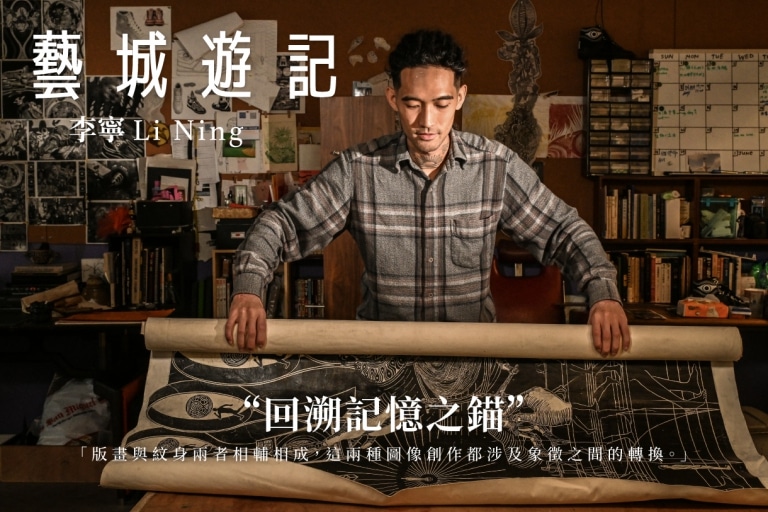
Lei Ning tattoo artist Lei Ning (李寧) blends relief printmaking and custom tattooing to turn surreal, science-fiction imagery into works on paper and on skin, a process that can take days of carving, inking, and pressing before the final image appears.
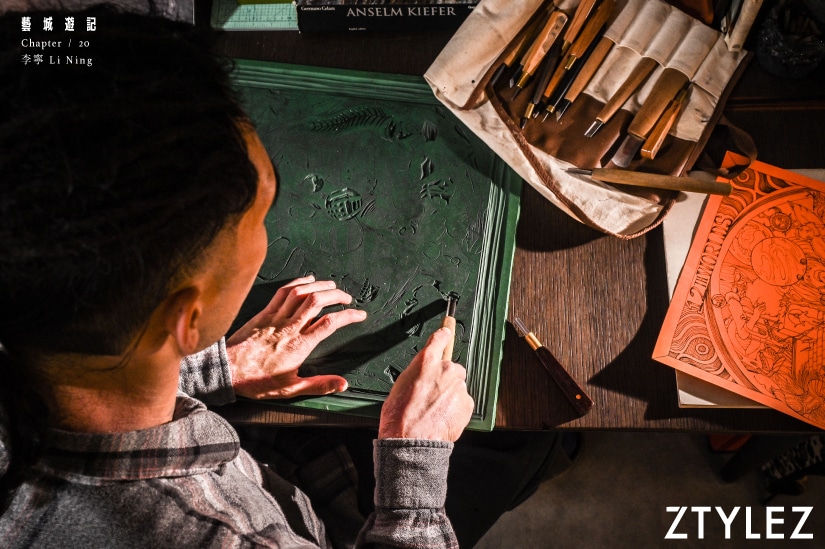
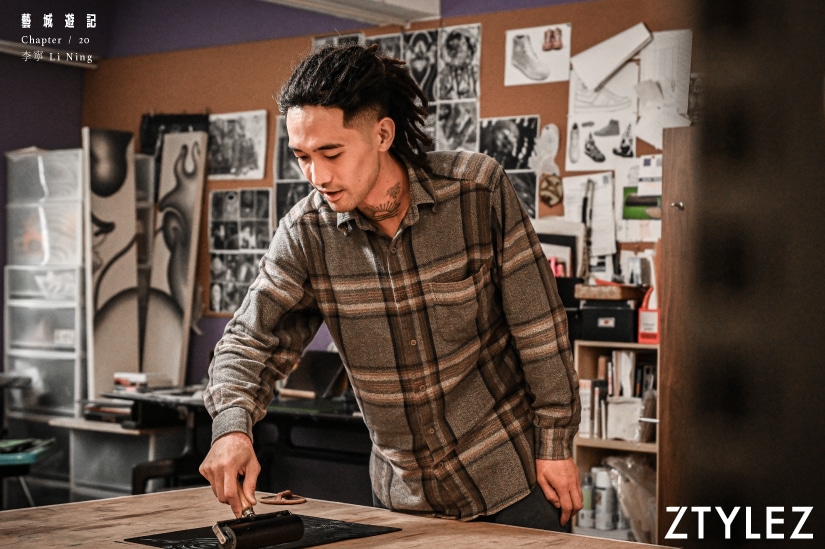
As both a printmaker and a tattoo artist, Lei Ning works with relief print techniques, where he carves away the parts of a plate that should not take ink, leaving the raised areas to be inked and pressed onto paper. In tattooing, he transfers imagery into living skin, adding pigment that cannot be erased, so his two practices feel like a pairing of subtraction and addition.
Whether he holds a carving knife or a tattoo needle, the moment of contact requires intense focus, as if time freezes. Visiting his studio, we unfolded the sequence of moments that produce his ideas and images.
About Lei Ning tattoo artist
When subconscious thought, dreams, imagination, and feeling overlap, they can weave an expansive, otherworldly space, Lei Ning said. Printmaking allows him to place objects from different times and scales in the same frame, and the press makes those juxtapositions read as if they belong together.
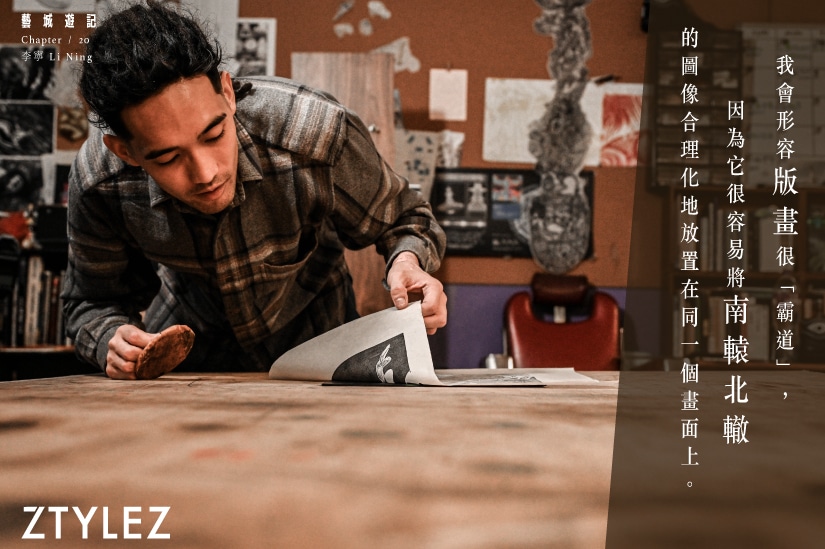
“I describe printmaking as very domineering.”
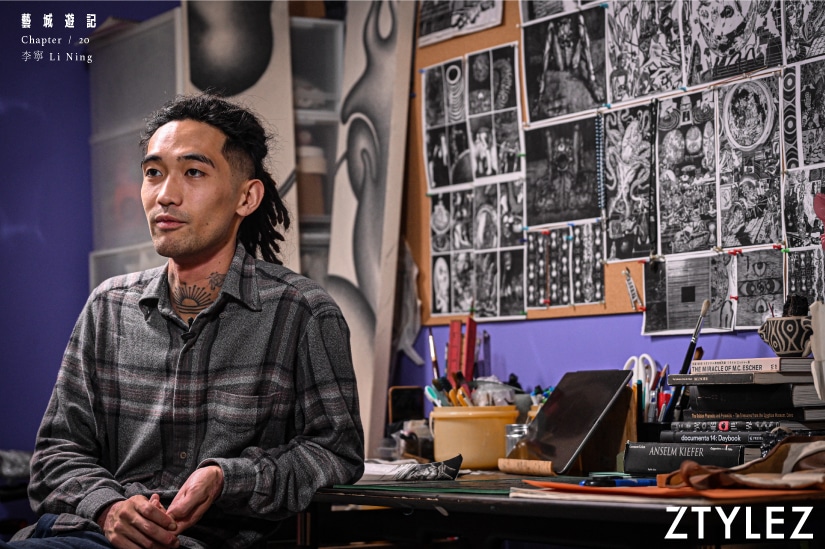
“Printmaking can rationalize very different images and place them at the same point under a single pressure and plane,” he said. “I would call it domineering, because whatever gets printed becomes reasonable in that pressed space.”
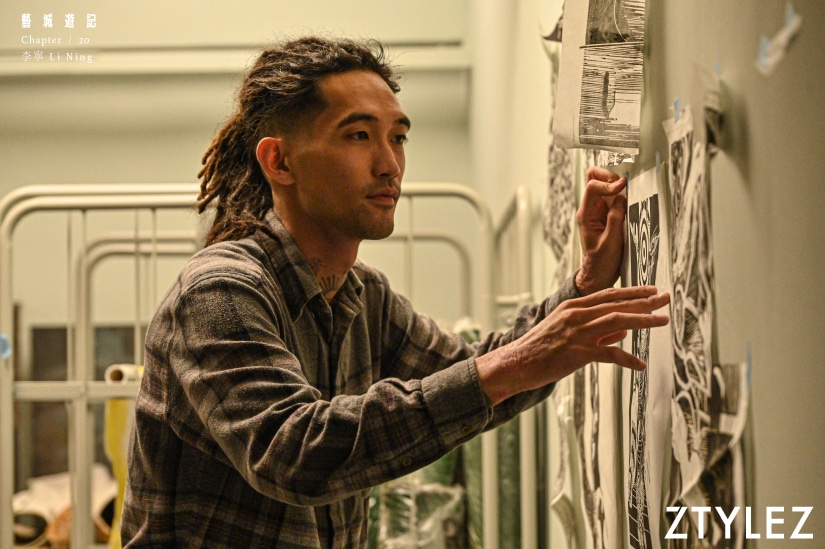
Influenced by mysticism, spiritual philosophy, and science fiction, his work often reads as surreal narratives that fold different temporal objects into one composition. His aim is to hold a viewer’s eye longer, he said, and to invite the audience to treat each work like a puzzle to explore rather than a problem to solve.
“I am good at finding novelty.”
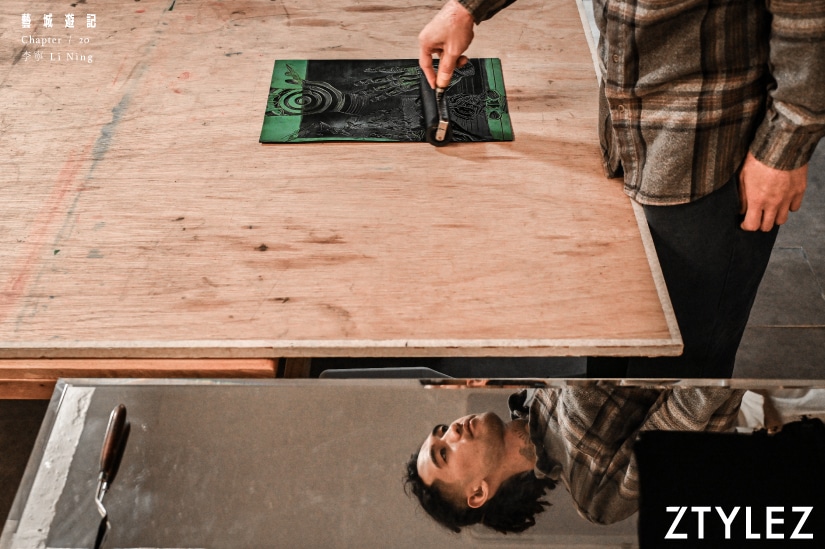
Lei Ning said his psychology lives in oscillation, and that searching for new stimuli is part of his creative method. “When I feel dull, I look for new things to see; before I find them I can feel depressed, when I find them I feel excited,” he said.
He listens to online radio shows and offbeat stories while he works, letting ideas from outside his own knowledge seep into his visual vocabulary. The result is dense narratives born of association, but he intentionally leaves interpretive space so viewers can supply personal meaning.
“Prints and tattoos support each other.”
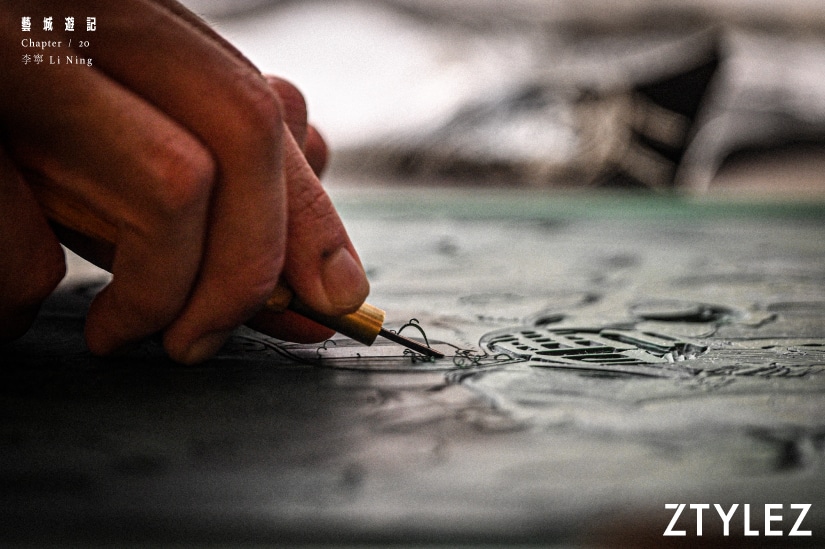
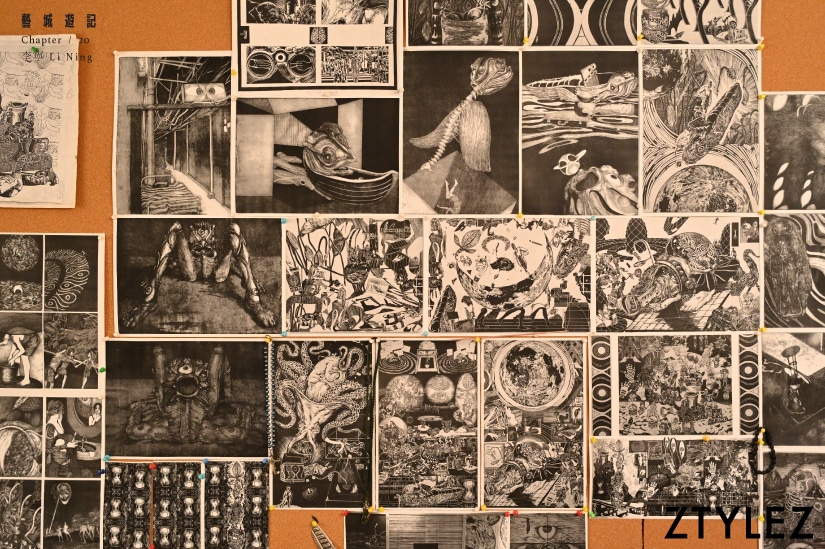
His move into printmaking grew out of tattoo practice. As a young artist he sketched many flash designs to build a reference library and covered his studio walls with them, which led to tightly packed linework in his early paintings. A teacher suggested he reduce elements, so he turned to printmaking to remove surface detail and focus composition by subtraction.
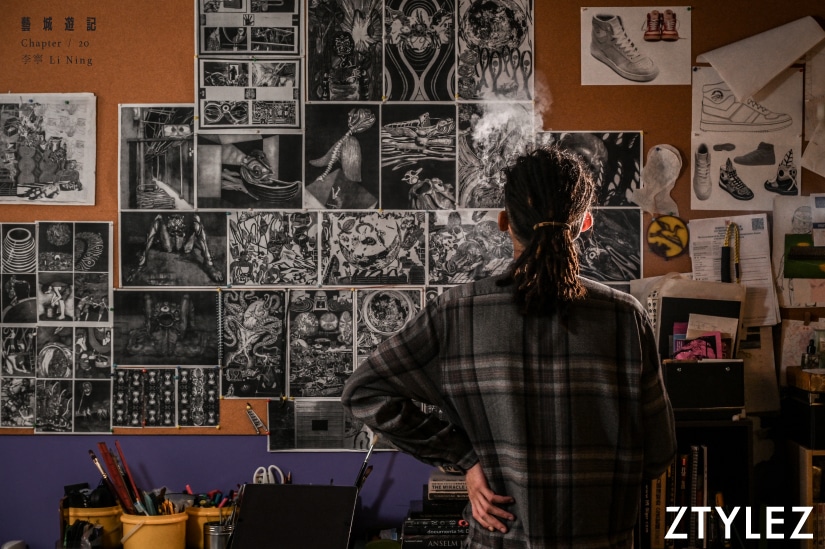
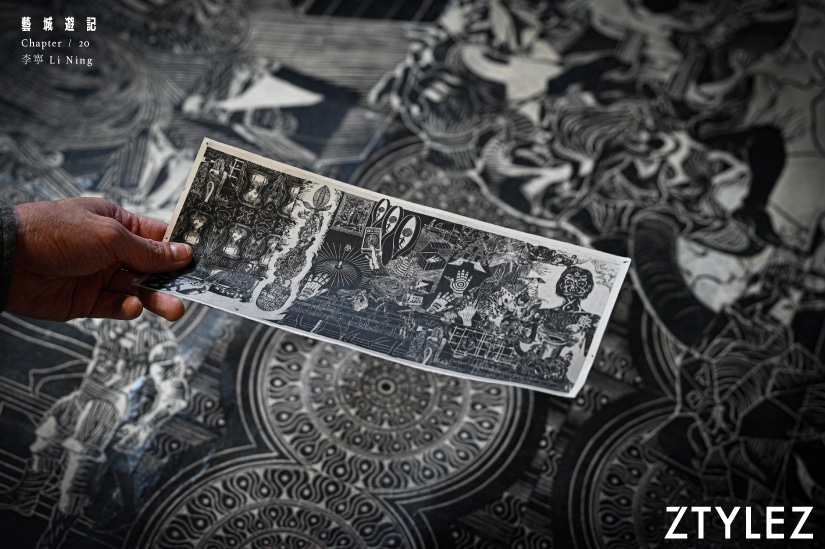
He prints plates onto Japanese paper, then collages different motifs together, a method that mirrors tattoo transfer techniques. The larger scale of a print lets him combine tattoo-sized images into a broader field of motifs and narratives.
“A tattoo can act as a memory anchor.”
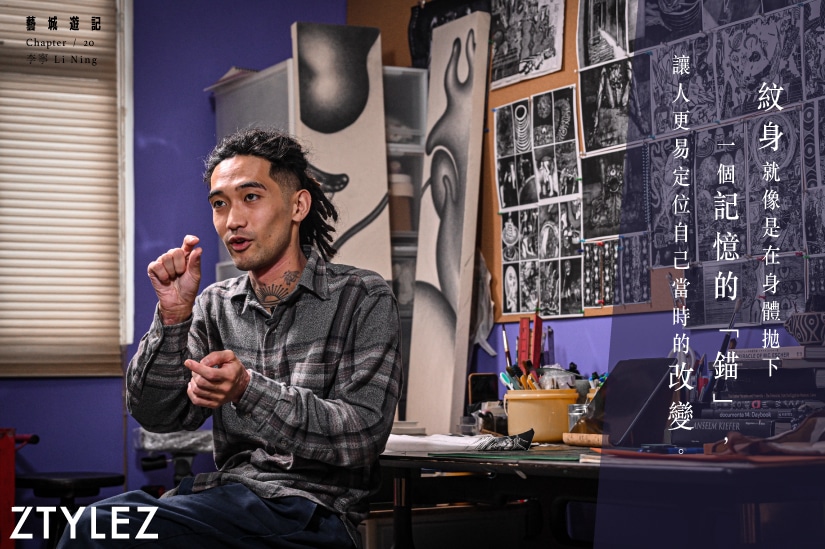
Self-taught as a tattooist, he experimented on his own skin in the early years and now has more than 10 years of professional experience. Because tattoo pigment is effectively irreversible once placed, the act of marking skin carries ritual weight for him.
“Leaving marks on skin is a very cool thing, because it is not easily changed,” he said. “As material, human skin is extreme. It is living, and the way your work is shown to the world is so singular. Those concepts attract me.”
For Lei Ning, the pain of tattooing is part of transformation. “Pain is one thing that changes people. The sensation stays in your mind and in your body,” he said. “A tattoo can act as a memory anchor, a point you can locate later when you think back to when you changed.”
He still finds excitement in the work. Without formal tattoo training, he refined technique through trial and error, and he values the daily surprises that keep him engaged. Many clients bring photographs, words, sounds, or feelings as reference, and he translates those inputs into personalized imagery.
“Tattooing is a situation where I explain something to you, and you have to trust me,” he said. “We exchange trust, and that bond lives on the human body.”
“The practice is a technique for meeting the world.”
Lei Ning said he cares more about the intellectual value his work presents than purely technical display. Creativity, to him, is a way to research and understand oneself, and that process changes a creator’s worldview.
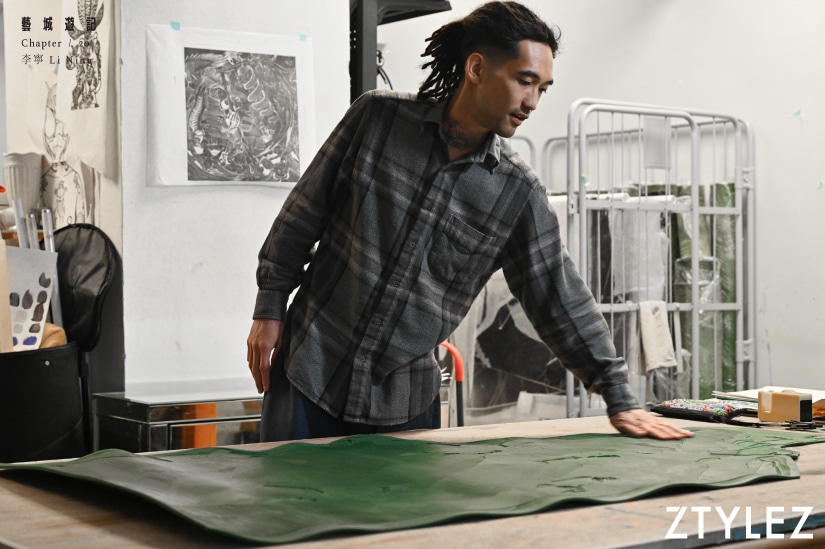
His prints are filled with intricate lines that, when combined, invite the viewer into a world of many things. He trains a mental pathway for converting symbols into refined motifs, whether the surface is paper or skin.
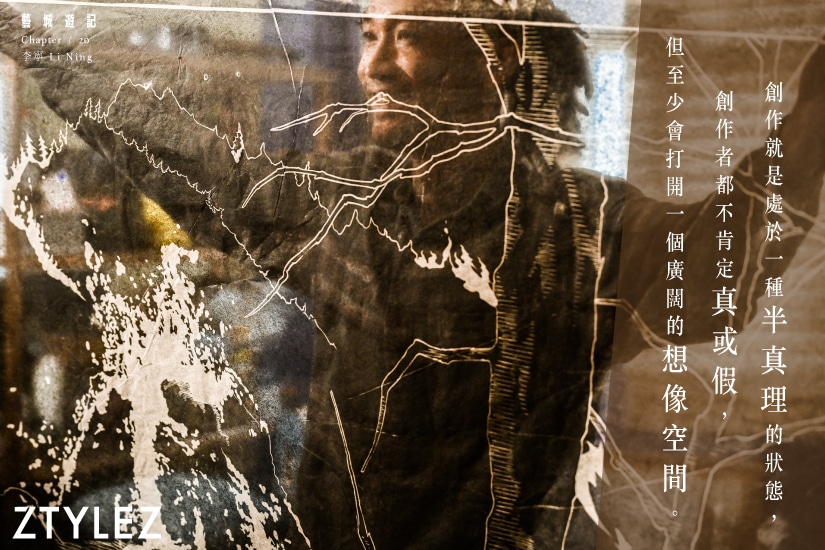
“Creation exists in a half-truth state. Creators are not certain about what is true or false, but they make it anyway,” he said. “Creation often contains an element of provocation, because you open an expansive imaginative space and see how people insert themselves into it.”
“I feel lucky to have started during shifting values.”
He believes tattoos carry more varied meaning for younger people today, from spiritual rituals to markers of personal turning points. “Now people want different values from tattoos,” he said.
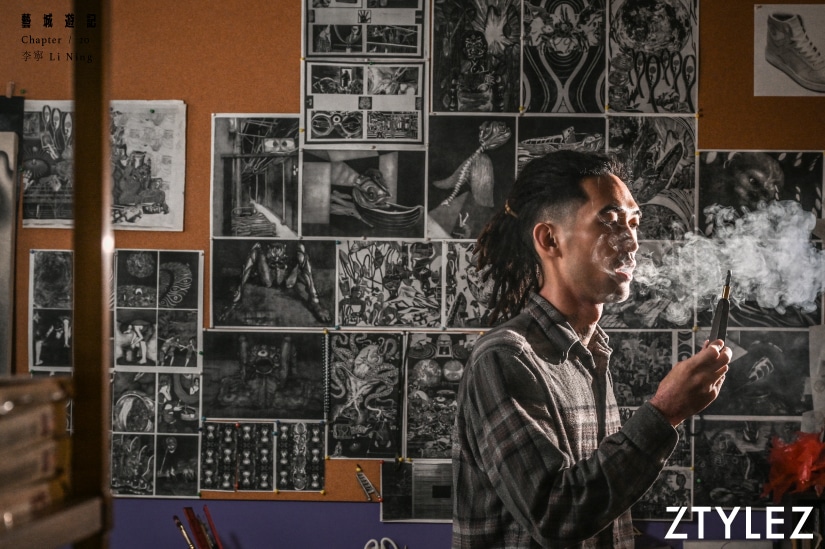
In Hong Kong, interest in printmaking has grown, he said, and the medium itself carries a persuasive quality because carved plates can be reprinted multiple times. If an image speaks to its era and to viewers, it increases the work’s reach and relevance.
The path of making art has many turns, he said, but what endures are the lines and the cycles of inspiration. Whether carved in a plate or etched into skin, an artist makes a mark that can serve as a memory anchor and a way for people to revisit the meaning of a moment.
Executive Producer: Angus Mok
Producer: Mimi Kong
Editor: Ruby Yiu
Videographer: Alvin Kong, Kason Tam
Video Editor: Alvin Kong
Photographer: Ken Yeung
Designer: Michael Choi
Special Thanks: Lei Ning